Stream Links and Projections
View SourceStream links enable derived streams from source streams through filtering and transformation. This guide covers the server-side implementation, lifecycle management, and use cases.
Overview
The reckon_db_links module provides:
| Function | Purpose |
|---|---|
create/2 | Create a new link definition |
delete/2 | Remove a link |
get/2 | Get link configuration |
list/1 | List all links |
start/2 | Start link processing |
stop/2 | Stop link processing |
info/2 | Get detailed link statistics |
Architecture
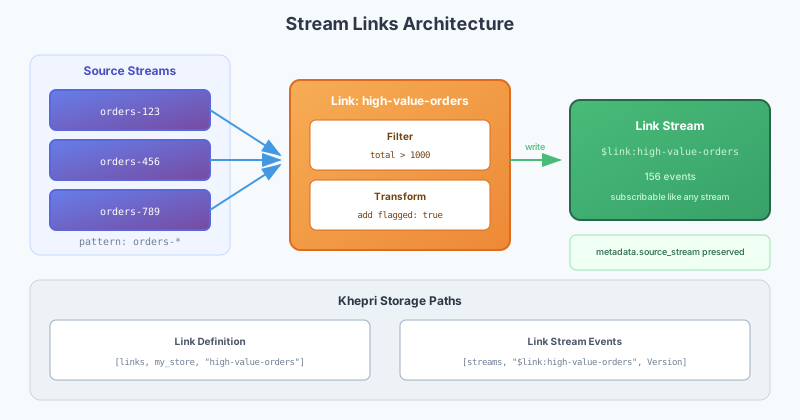
What is a Stream Link?
A stream link is a derived stream that:
- Subscribes to one or more source streams
- Filters events based on a predicate function
- Transforms events (optional) before writing
- Writes matching events to a link stream
Link streams are named with a $link: prefix and behave like regular streams.
Creating Links
Basic Link
ok = reckon_db_links:create(my_store, #{
    name => <<"high-value-orders">>,
    source => #{type => stream_pattern, pattern => <<"orders-*">>},
    filter => fun(E) -> maps:get(total, E#event.data, 0) > 1000 end
}).
Link with Transform
ok = reckon_db_links:create(my_store, #{
    name => <<"flagged-orders">>,
    source => #{type => stream_pattern, pattern => <<"orders-*">>},
    filter => fun(E) -> maps:get(total, E#event.data, 0) > 5000 end,
    transform => fun(E) ->
        NewData = maps:put(flagged, true, E#event.data),
        NewData2 = maps:put(flagged_at, erlang:system_time(millisecond), NewData),
        E#event{data = NewData2}
    end
}).
Link with Backfill
Process existing events when starting:
ok = reckon_db_links:create(my_store, #{
    name => <<"all-payments">>,
    source => #{type => stream_pattern, pattern => <<"payments-*">>},
    backfill => true  %% Process existing events on start
}).
Source Specifications
Single Stream
source => #{type => stream, stream_id => <<"orders-018f6a7b8c9d4e5f60718293a4b5c6db">>}Stream Pattern (Wildcard)
source => #{type => stream_pattern, pattern => <<"orders-*">>}
source => #{type => stream_pattern, pattern => <<"*-completed">>}
All Streams
source => #{type => all}
%% Excludes $link: streams to prevent loops
A link never follows its own stream. A stream_pattern link follows other
$link: streams only when its pattern starts with $link:, so a pattern
such as * does not pick up derived streams. Two such $link: pattern
links whose patterns match each other's streams feed each other without
end: every event one writes is a source event for the other.
create/2 refuses a source it cannot follow with
{error, {invalid_source, Source}} and stores nothing: a stream source
needs a non-empty binary stream_id (not the link's own stream), a
stream_pattern source a non-empty binary pattern.
Link Lifecycle
Starting a Link
ok = reckon_db_links:start(my_store, <<"high-value-orders">>).This starts the link's consumer, one process per running link in the cluster, which:
- Subscribes to the source: the stream itself for a
streamsource,$all(with the source match applied per event) forstream_patternandall - Sets the link status to
running - Writes the backfill if
backfill => true: every matching stream, read from its start - Follows the source live from there
If the link cannot subscribe, start/2 answers the subscribe error and the
link keeps its status.
Stopping a Link
ok = reckon_db_links:stop(my_store, <<"high-value-orders">>).This:
- Ends the link's consumer and removes its subscription
- Updates link status to
stopped
A later start/2 continues from where the link stopped, so the link also
gets the events the source received in between.
Restarts and Crashes
The consumer stores, with the link, the last version it has handled in each source stream. An event at or below it is passed over, and a gap is read from the source stream before the next event is taken. So each source event that passes the filter is in the link stream once:
- a consumer that crashes is restarted by its supervisor and picks up from the stored positions;
- a link stored as
runningis resumed when the store's leader activates, after a restart or a leadership change, including what the source received while it was down.
With the positions it stores the link-stream version its last append reached. On start, every link-stream event past that version raises its source stream's position, so an append that landed just before a crash, with events from one source stream or several, is not written again.
A Link That Cannot Progress
A transform that crashes or returns something other than an #event{}, or
an event in the link stream that does not name its source position, would
fail again on every restart. The link stops instead:
- it writes the events it took before that one, and nothing for that one: never the untransformed event, so a transform that redacts cannot leak what it was meant to remove;
- it removes its subscription and its status becomes
error, with areasonthat names the source position and not the event's data:{transform_crashed, Stream, Version, Class},{transform_returned_no_event, Stream, Version}or{unreadable_link_event, LinkStreamVersion}; - its consumer ends normally, so it is not restarted, and every other link in the store keeps running.
Fix the transform (recreate the link) and start/2 it again. A filter that
crashes selects nothing for that event; the link goes on.
The derived event keeps the source event's id and type, and its metadata
names where it came from: source_stream and source_version.
Checking Link Status
{ok, Info} = reckon_db_links:info(my_store, <<"high-value-orders">>),
%% #{
%%     name => <<"high-value-orders">>,
%%     source => #{type => stream_pattern, pattern => <<"orders-*">>},
%%     status => running,
%%     processed => 1523,
%%     link_stream => <<"$link:high-value-orders">>,
%%     link_stream_version => 156,
%%     created_at => 1735689600000,
%%     last_event => <<"evt-789">>
%% }
A link with status error also carries reason, in info/2, get/2 and
list/1.
Khepri Storage
Link Definitions
Links are stored at:
[links, StoreId, LinkName] -> #link{} recordLink Streams
Link output is written to:
[streams, <<"$link:LinkName">>, PaddedVersion] -> #event{}Link Record Structure
-record(link, {
    name :: binary(),
    source :: source_spec(),
    filter :: fun((event()) -> boolean()) | undefined,
    transform :: fun((event()) -> event()) | undefined,
    backfill :: boolean(),
    created_at :: integer(),
    status = stopped :: running | stopped | error,
    processed = 0 :: non_neg_integer(),
    last_event :: binary() | undefined,
    positions :: #{binary() => integer()} | undefined,
    link_version = -1 :: integer(),
    reason :: term()
}).
Subscribing to Link Streams
Link streams are regular streams:
%% Subscribe to the link stream
reckon_db_subscriptions:subscribe(
    my_store,
    stream,
    <<"$link:high-value-orders">>,
    <<"my-subscription">>,
    #{handler => fun handle_high_value_order/1}
).

%% Read from the link stream
{ok, Events} = reckon_db_streams:read(
    my_store,
    <<"$link:high-value-orders">>,
    0, 100, forward
).
Event Transformation
Preserved Metadata
When events are written to link streams, source information is preserved:
event_to_map(#event{stream_id = S, version = V}, Derived) ->
    #{
        event_id => Derived#event.event_id,
        event_type => Derived#event.event_type,
        data => Derived#event.data,
        metadata => maps:merge(Derived#event.metadata, #{
            source_stream => S,
            source_version => V
        })
    }.
Derived is what the transform returned (the source event itself without
one). source_stream and source_version name the source event, whatever
the transform did to the event's own stream id and version.
Custom Transforms
Transform functions receive the full event record:
transform => fun(Event) ->
    %% Add computed field
    Data = Event#event.data,
    Total = maps:get(quantity, Data, 0) * maps:get(price, Data, 0),
    NewData = maps:put(computed_total, Total, Data),

    %% Return modified event
    Event#event{data = NewData}
end
Pattern Matching
Wildcard patterns are converted to regex:
wildcard_to_regex(Pattern) ->
    Escaped = re:replace(Pattern, <<"[.^$+?{}\\[\\]\\\\|()]">>,
                         <<"\\\\&">>, [global, {return, binary}]),
    Converted = binary:replace(Escaped, <<"*">>, <<".*">>, [global]),
    <<"^", Converted/binary, "$">>.
Examples:
orders-*matches everyordersstream, such asorders-018f6a7b8c9d4e5f60718293a4b5c6dborder*matches both theorderand theordersstreams*-018f*matches streams of any prefix whose id starts with018f
A pattern is matched against whole stream ids, which always have the shape
<prefix>-<32 hex> (see Stream Ids).
Use Cases
1. Event Type Aggregation
Collect all payment events across customer streams:
ok = reckon_db_links:create(my_store, #{
    name => <<"all-payments">>,
    source => #{type => all},
    filter => fun(E) ->
        EventType = E#event.event_type,
        EventType =:= <<"PaymentReceived">> orelse
        EventType =:= <<"PaymentFailed">> orelse
        EventType =:= <<"RefundIssued">>
    end,
    backfill => true
}).
2. High-Value Transaction Monitoring
ok = reckon_db_links:create(my_store, #{
    name => <<"high-value-txns">>,
    source => #{type => stream_pattern, pattern => <<"account-*">>},
    filter => fun(E) ->
        Amount = abs(maps:get(amount, E#event.data, 0)),
        Amount > 10000
    end,
    transform => fun(E) ->
        E#event{metadata = maps:put(flagged_reason, <<"high_value">>,
                                     E#event.metadata)}
    end
}).
3. Audit Trail
ok = reckon_db_links:create(my_store, #{
    name => <<"security-audit">>,
    source => #{type => all},
    filter => fun(E) ->
        EventType = E#event.event_type,
        lists:member(EventType, [
            <<"UserLoggedIn">>,
            <<"PasswordChanged">>,
            <<"PermissionGranted">>,
            <<"DataExported">>
        ])
    end
}).
4. Real-Time Analytics Feed
ok = reckon_db_links:create(my_store, #{
    name => <<"analytics-feed">>,
    source => #{type => all},
    filter => fun(_) -> true end,  %% All events
    transform => fun(E) ->
        %% Strip PII, keep only analytics-relevant fields
        SafeData = maps:with([event_type, timestamp, stream_id], #{
            event_type => E#event.event_type,
            timestamp => E#event.epoch_us,
            stream_id => E#event.stream_id
        }),
        E#event{data = SafeData}
    end
}).
Telemetry
Link operations emit telemetry:
%% Event: [reckon_db, link, created | started | stopped | deleted]
%% Measurements: #{system_time => integer()}
%% Metadata: #{store_id => atom(), link_name => binary()}
Error Handling
| Error | Cause | Resolution |
|---|---|---|
{error, not_found} | Link does not exist | Verify link name |
{error, already_exists} | Link name in use | Choose different name |
| Filter crash | Filter function threw exception | Returns false (event skipped) |
| Transform crash | Transform function threw exception | Link stops, status error, reason {transform_crashed, ...}; nothing written for that event |
| Transform returned no event | Transform returned something other than #event{} | Link stops, status error, reason {transform_returned_no_event, ...} |
Best Practices
1. Use Defensive Filters
filter => fun(E) ->
    try
        maps:get(amount, E#event.data, 0) > 1000
    catch
        _:_ -> false
    end
end
2. Avoid Expensive Transforms
Transforms run for every matching event. Keep them lightweight.
3. Consider Backfill Costs
Backfill reads every matching stream from its start, 500 events per read,
before the link follows live events (those wait in the consumer's mailbox
meanwhile). For large sources, consider whether the link needs the history
at all: without backfill, a new link starts at each stream's current
version.
4. Gateway Clients Do Not See Link Errors
Through the gateway, create_link, start_link, stop_link and
delete_link are casts: a refused source or a failed start is logged on
the store's node, not returned. Check the link with get_link or
link_info afterwards.
5. Monitor Processed Counts
%% Check link is keeping up
{ok, Info} = reckon_db_links:info(my_store, <<"my-link">>),
Processed = maps:get(processed, Info),
%% Alert if falling behind
See Also
- Subscriptions - Event subscription patterns
- Storage Internals - Khepri path structure