Storage Internals
View SourceThis guide covers the internal storage architecture of reckon-db, including Khepri path structures, data organization, and cluster replication behavior.
Overview
reckon-db uses Khepri as its storage layer. Khepri is a tree-like key-value store built on Ra (Raft consensus), providing:
- Strong consistency across cluster nodes
- Automatic replication
- Tree-structured data organization
- Efficient prefix queries
Architecture
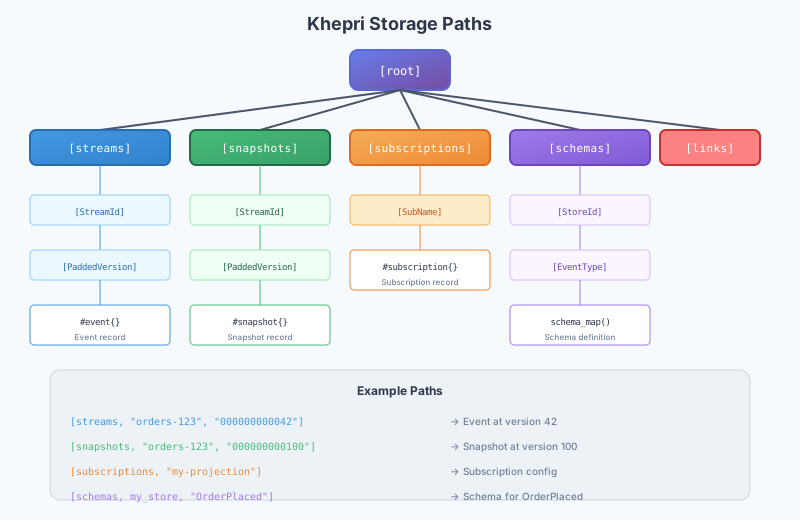
Khepri Path Structure
All data is organized under hierarchical paths:
[root]
├── [streams]
│   └── [StreamId]
│       └── [PaddedVersion] -> #event{}
├── [snapshots]
│   └── [StreamId]
│       └── [PaddedVersion] -> #snapshot{}
├── [subscriptions]
│   └── [SubscriptionName] -> #subscription{}
├── [schemas]
│   └── [StoreId]
│       └── [EventType] -> schema_map()
├── [links]
│   └── [StoreId]
│       └── [LinkName] -> #link{}
└── [metadata]
    └── [Key] -> Value
Streams Storage
Path Format
?STREAMS_PATH ++ [Type, Id, PaddedVersion]
%% Example: [streams, <<"orders">>, <<"018f6a7b8c9d4e5f60718293a4b5c6db">>, <<"000000000042">>]
Version Padding
Versions are zero-padded to 12 characters for lexicographic ordering:
-define(VERSION_PADDING, 12).

pad_version(Version, Length) ->
    VersionStr = integer_to_list(Version),
    Padding = Length - length(VersionStr),
    PaddedStr = lists:duplicate(Padding, $0) ++ VersionStr,
    list_to_binary(PaddedStr).

%% Examples:
%% 0 -> <<"000000000000">>
%% 42 -> <<"000000000042">>
%% 999999999999 -> <<"999999999999">>
This supports up to 999,999,999,999 events per stream (~317 years at 100 events/sec).
Event Record
-record(event, {
    event_id :: binary(),           %% UUID
    stream_id :: binary(),          %% Stream identifier
    version :: non_neg_integer(),   %% 0-indexed position
    event_type :: binary(),         %% Event type name
    data :: map(),                  %% Event payload
    metadata :: map(),              %% Event metadata
    epoch_us :: integer()           %% Timestamp (microseconds since epoch)
}).
Reading Events
Events are read using Khepri path queries:
%% Read specific version
khepri:get(StoreId, [streams, StreamId, PaddedVersion]).

%% Read range of versions
Pattern = [streams, StreamId, ?KHEPRI_WILDCARD_STAR],
khepri:get_many(StoreId, Pattern).
Snapshots Storage
Path Format
?SNAPSHOTS_PATH ++ [StreamId, PaddedVersion]
%% Example: [snapshots, <<"orders-018f6a7b8c9d4e5f60718293a4b5c6db">>, <<"000000000100">>]
Snapshot Record
-record(snapshot, {
    stream_id :: binary(),
    version :: non_neg_integer(),   %% Event version this snapshot represents
    state :: term(),                %% Serialized aggregate state
    metadata :: map(),
    created_at :: integer()         %% Timestamp
}).
Latest Snapshot Query
%% Get all snapshots for a stream, sorted by version descending
Pattern = [snapshots, StreamId, ?KHEPRI_WILDCARD_STAR],
{ok, Snapshots} = khepri:get_many(StoreId, Pattern),
%% Sort by version descending to get latest first
Subscriptions Storage
Path Format
?SUBSCRIPTIONS_PATH ++ [SubscriptionName]
%% Example: [subscriptions, <<"my-projection">>]
Subscription Record
-record(subscription, {
    name :: binary(),
    type :: stream | event_type | event_pattern | event_payload,
    selector :: binary() | map(),
    handler :: pid() | function(),
    options :: map(),
    created_at :: integer()
}).
Schema Registry Storage
Path Format
?SCHEMAS_PATH ++ [StoreId, EventType]
%% Example: [schemas, my_store, <<"OrderPlaced">>]
Schema Structure
#{
    event_type => <<"OrderPlaced">>,
    version => 3,
    upcast_from => #{
        1 => fun(Data) -> ... end,
        2 => fun(Data) -> ... end
    },
    validator => fun(Data) -> ok | {error, Reason} end,
    description => <<"Current order event schema">>,
    registered_at => 1735689600000
}
Links Storage
Path Format
?LINKS_PATH ++ [StoreId, LinkName]
%% Example: [links, my_store, <<"high-value-orders">>]
Link Record
-record(link, {
    name :: binary(),
    source :: source_spec(),
    filter :: fun((event()) -> boolean()) | undefined,
    transform :: fun((event()) -> event()) | undefined,
    backfill :: boolean(),
    created_at :: integer(),
    status :: running | stopped | error,
    processed :: non_neg_integer(),
    last_event :: binary() | undefined
}).
Cluster Replication
Ra Consensus
All writes go through Raft consensus:
   Write Request
        │
        ▼
   ┌─────────┐
   │  Leader │ ◄─── All writes go here
   └────┬────┘
        │
   ┌────┴────┬────────┐
   │         │        │
   ▼         ▼        ▼
┌──────┐ ┌──────┐ ┌──────┐
│Follow│ │Follow│ │Follow│
│  1   │ │  2   │ │  3   │
└──────┘ └──────┘ └──────┘
Consistency Guarantees
| Operation | Guarantee |
|---|---|
| Write (append) | Strongly consistent (quorum) |
| Read | Strongly consistent (from leader) |
| Cross-stream | No transaction (best effort) |
Failover Behavior
- Leader fails
- Ra elects new leader (typically < 1 second)
- Writes resume on new leader
- In-flight writes may need retry
Storage Operations
Writing Events
%% Append event
PaddedVersion = pad_version(Version, ?VERSION_PADDING),
Path = [streams, StreamId, PaddedVersion],
khepri:put(StoreId, Path, Event).
Reading Events
%% Read specific version
{ok, Event} = khepri:get(StoreId, [streams, StreamId, PaddedVersion]).

%% Read all events in stream
Pattern = [streams, StreamId, ?KHEPRI_WILDCARD_STAR],
{ok, EventsMap} = khepri:get_many(StoreId, Pattern).
Deleting Events (Scavenging)
%% Delete individual event
khepri:delete(StoreId, [streams, StreamId, PaddedVersion]).
Listing Streams
%% Get all stream IDs
Pattern = [streams, ?KHEPRI_WILDCARD_STAR],
{ok, StreamNodes} = khepri:get_many(StoreId, Pattern),
StreamIds = maps:keys(StreamNodes).
Memory Considerations
Khepri In-Memory
Khepri keeps data in memory for fast access:
- All paths and values are in memory
- Raft log is also in memory (up to snapshot interval)
- Consider total event size when planning capacity
Memory Estimation
%% Rough estimate per event
EventMemory = byte_size(term_to_binary(Event)),
TotalEvents = 1000000,
ApproxMemory = EventMemory * TotalEvents * 1.5,  %% 1.5x for overhead
Reducing Memory
- Scavenging: Remove old events
- Snapshots: Enable state recovery without all events
- Archival: Move to cold storage before scavenging
Disk Persistence
Ra Snapshots
Ra periodically snapshots the Raft log to disk:
%% Default location
DataDir = application:get_env(ra, data_dir, "ra_data"),
%% Store-specific subdirectory
StoreDir = filename:join(DataDir, atom_to_list(StoreId)).
Snapshot Interval
Configure via Ra settings:
%% In sys.config
{ra, [
    {segment_max_entries, 65536},    %% Entries per segment
    {wal_max_size_bytes, 134217728}  %% 128MB WAL size
]}
Querying Patterns
Prefix Queries
%% All events for a stream
[streams, <<"orders">>, <<"018f6a7b8c9d4e5f60718293a4b5c6db">>, ?KHEPRI_WILDCARD_STAR]

%% All snapshots for a stream
[snapshots, <<"orders-018f6a7b8c9d4e5f60718293a4b5c6db">>, ?KHEPRI_WILDCARD_STAR]
Existence Checks
%% Check if stream exists
case khepri:exists(StoreId, [streams, StreamId]) of
    true -> stream_exists;
    false -> no_stream
end.
Conditional Updates
Use reckon_db_streams:append/4 for a conditional write. It reads the
version, builds the records and their index entries, and verifies inside the
write transaction that the version node the batch would occupy is still free.
%% Optimistic concurrency via expected version
case reckon_db_streams:append(StoreId, StreamId, ExpectedVersion, Events) of
    {ok, NewVersion} ->
        NewVersion;
    {error, {wrong_expected_version, Expected, Current}} ->
        {error, {wrong_expected_version, Expected, Current}};
    {error, {version_conflict, Expected, Current}} ->
        %% Lost the race 60 times in a row: the stream is under heavy
        %% contention and this append was not written.
        {error, {version_conflict, Expected, Current}};
    {error, {version_unverifiable, Version, _Reason}} = Error ->
        %% The version could not be checked against the stream: its older
        %% events were scavenged (see below), or it was deleted underneath
        %% the append. Retrying will not help.
        Error
end.
Do not write the version check by hand as a khepri:get followed by a
khepri:put: between the two, another writer can take the same version and
your put overwrites its events, with both calls answering ok. That is the
data loss 5.11.13 fixed in append/4, and a hand-written check reopens it.
The version is the count of the stream's live version nodes minus one, and a
scavenge (reckon_db_scavenge:scavenge/3) deletes old nodes without
renumbering the rest. On a scavenged stream the count is therefore below the
newest event, and the append refuses with
{error, {version_unverifiable, _, _}} rather than overwriting: either the
node it would write already holds a live event, or the node before it is
gone. Which of the two depends on how much was scavenged: the first holds
for a short prefix, the second for a batch that would fit below the
survivors. The check covers the node before the batch as well, because
a batch short enough can fit entirely below the surviving events. A scavenge
that deletes every event leaves no nodes at all, so the count reads -1 and
the next ANY_VERSION append starts the stream again at version 0. 5.12.0
keeps the version in a per-stream counter, written in the same transaction as
the events, and is exact again after a scavenge.
Performance Tips
1. Batch Writes
%% Write multiple events in single Ra command
Events = [Event1, Event2, Event3],
khepri:transaction(StoreId, fun() ->
    lists:foreach(fun(E) ->
        khepri:put([streams, StreamId, pad_version(E#event.version)], E)
    end, Events)
end).
2. Use Snapshots
%% Avoid replaying thousands of events
{ok, Snapshot} = load_latest_snapshot(StoreId, StreamId),
{ok, NewEvents} = read_events_since(StoreId, StreamId, Snapshot#snapshot.version),
State = apply_events(Snapshot#snapshot.state, NewEvents).
3. Monitor Memory
%% Check Khepri memory usage
KhepriInfo = khepri:info(StoreId),
MemoryUsed = proplists:get_value(memory, KhepriInfo).
Troubleshooting
Common Issues
| Issue | Cause | Resolution |
|---|---|---|
| Slow writes | No quorum | Check cluster health |
| High memory | Too many events | Enable scavenging |
| Stale reads | Reading during partition | Wait for partition heal |
Diagnostic Commands
%% Cluster status
ra:members(StoreId).

%% Leader info
khepri:get_leader(StoreId).

%% Store statistics
khepri:info(StoreId).
See Also
- Temporal Queries - Time-based event retrieval
- Scavenging - Event lifecycle management
- Memory Pressure - Memory monitoring